
Who should consider screening
Screening with an upper endoscopy may be recommended for people with chronic reflux plus several risk factors, such as:
- Male sex
- Age over 50
- White race
- Smoking history
- Central obesity
- A family history of Barrett's or esophageal cancer
Diagnosis
Barrett's is diagnosed with an upper endoscopy and biopsies. The biopsies show whether there is dysplasia, which means precancerous change, and how advanced it is.
Treatment and surveillance
- No dysplasia: reflux control and periodic surveillance endoscopy, often every 3 to 5 years
- Low-grade dysplasia: closer surveillance or endoscopic treatment
- High-grade dysplasia or early cancer: endoscopic therapy, such as removal of abnormal tissue and ablation, which often avoids surgery
Most people also take an acid-reducing medicine to control reflux.
Common questions
Does Barrett's cause symptoms?
Not on its own. Symptoms come from the reflux.
Will it turn into cancer?
For most people, no. Surveillance is how changes are caught early, when they're most treatable.
Questions about Barrett's esophagus? Call (813) 400-0543 or send a message.
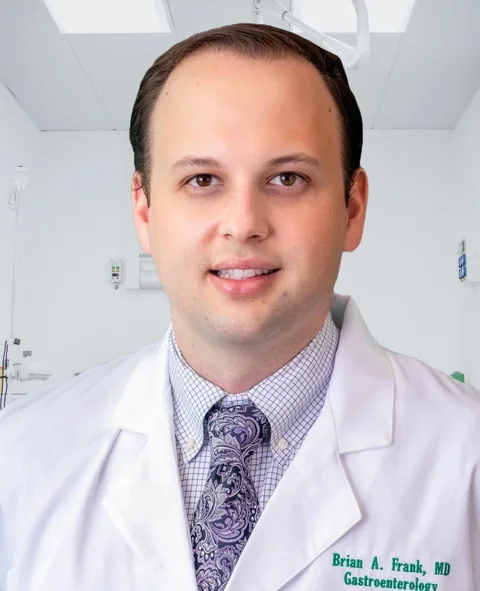
Written and reviewed by Brian Frank, MD
Board-certified gastroenterologist (ABIM). Last reviewed October 8, 2026.
Board-certified gastroenterologist (ABIM). Last reviewed October 8, 2026.
This page is general information, not medical advice. For a medical emergency, call 911.